Fact-Check Epilogue: What Stood the Test of Time vs. What Faded into Fiction
1. The Crypto Betting Market: Reality Check on the Numbers
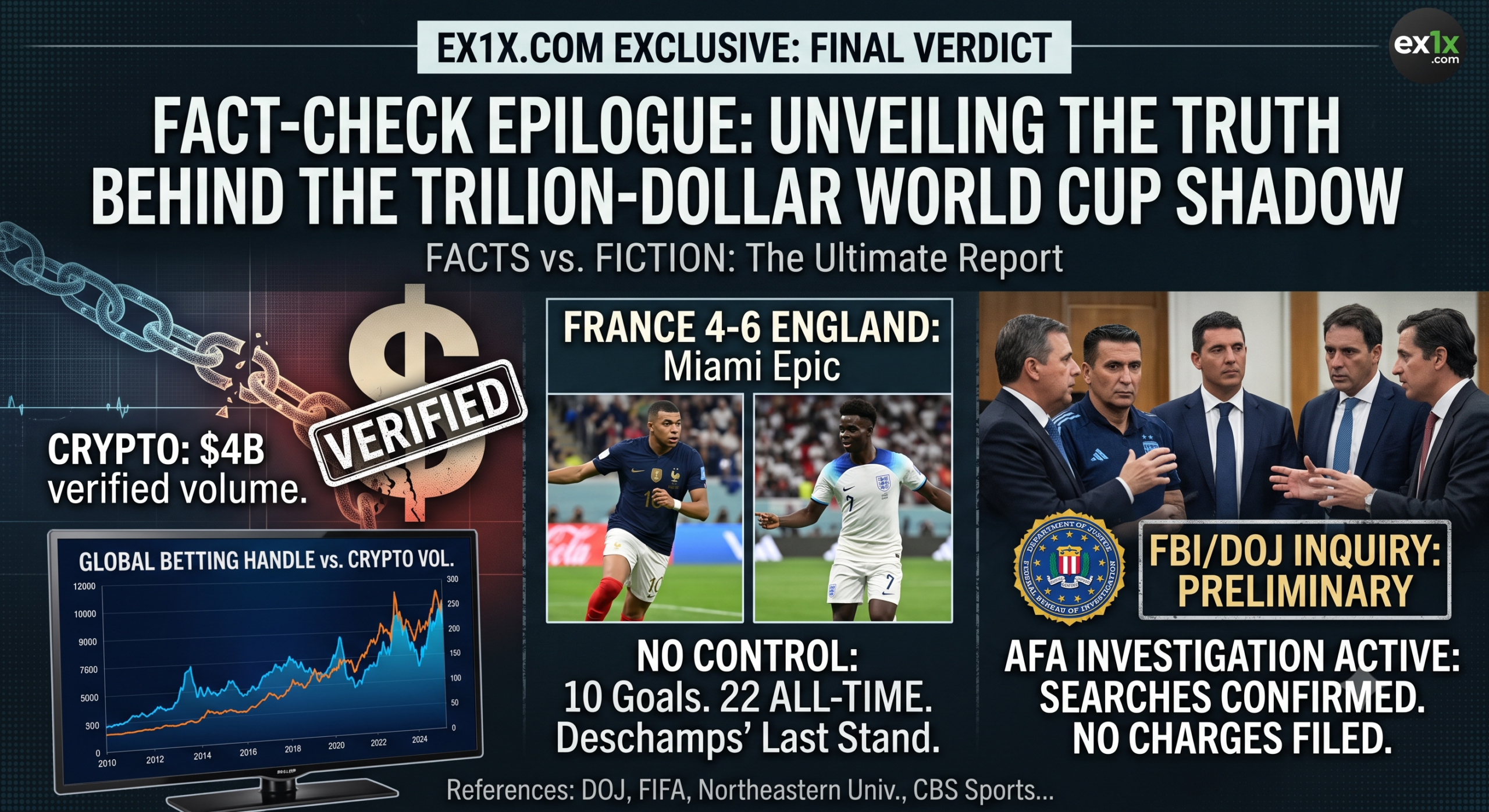
What was claimed: Between $200 billion and $600 billion in capital circulated during the 2-hour live window of a single high-voltage match.
What was verified:
Polymarket and Kalshi recorded a combined total of $4.27 billion in trading volume for the “World Cup Winner” market over the entire tournament. This set a new record for single-event prediction trading. The final match alone generated over $1 billion in crypto prediction volume, bringing the overall tournament total across major platforms between $3 billion and $10 billion.
The massive $593 billion figure cited by sports analytics expert Ismail Vali represents the estimated global betting handle—encompassing all legal and offshore sportsbooks worldwide, rather than crypto platforms alone.
Conclusion: Crypto prediction markets reached an unprecedented scale, with over $4 billion officially verified. However, the multi-hundred-billion-dollar figures belong to estimates of the total global sports betting handle across all traditional and offshore channels, not crypto alone.
—
2. France vs. England: Was the 10-Goal Match Controlled?
What was claimed: The third-place playoff was a pre-arranged “liquidity generator” where both defensive lines deliberately allowed goals to maintain live micro-betting interest.
What actually happened:
England defeated France 6-4 in a high-scoring third-place playoff in Miami. The ten-goal scoreline marked the highest-scoring World Cup match since 1982 and set a record for a third-place fixture. England established a dominant 4-0 lead by halftime, featuring early goals from Declan Rice and Ezri Konsa alongside a rapid brace from Buk Bukayo Saka. In the second half, France mounted a strong comeback to bring the score to 4-3 before a late Saka penalty and a goal from Jude Bellingham sealed the 6-4 result. Kylian Mbappé scored twice, becoming the World Cup’s all-time leading goalscorer with 22 goals.
The match reflected two exhausted squads playing an open, unstructured game. Rather than passivity, the second half showed a determined effort from France in manager Didier Deschamps’ final match, while England attacked aggressively from the opening whistle.
Conclusion: The claims of a pre-arranged script lack analytical backing. The match followed the typical high-scoring, open pattern often seen in third-place consolidation games where tournament pressure is off.
—
3. Institutional Bias Claims: Did Argentina Receive Special Treatment?
What was claimed: Argentina was the institutional favorite, and officiating decisions were structurally steered to ensure their progression.
What was verified:
* The Egypt Match: Egypt head coach Hossam Hassan publicly questioned key refereeing decisions, including a disallowed goal and a denied stoppage-time penalty appeal right before Argentina’s winning goal. FIFA’s Chief Refereeing Officer, Pierluigi Collina, dismissed accusations of institutional interference, stating that no outside official, including the FIFA President, could influence match officiating.
* The VAR Metrics: Data compiled by Northeastern University indicated that Argentina received favorable VAR overturns at a rate of 6.7 per 100 fouls. However, Mexico saw a higher rate at 7.8. Analysts emphasized that these metrics track how often VAR corrected missed calls, rather than serving as proof of structural bias.
* The Semifinal Referees: While critics labeled American referee Ismail Elfath as highly favorable to the squad, the semifinal match concluded in a conventional 2-1 victory earned through standard play.
* Universal Tech Disputes: Major nations, including England, Germany, and Iran, encountered controversial VAR decisions that went against them during both the group and knockout stages, indicating that technology application was a general point of friction rather than a targeted agenda.
* The Final Scoreline: Spain won the World Cup Final 1-0 in a dominant performance, limiting Argentina to just two shots and an expected goals (xG) metric of 0.20 compared to Spain’s 1.94.
Conclusion: Statistical data shows minor variances in VAR corrections, but there is no verified evidence of institutional corruption. The clear 1-0 defeat to Spain in the final remains the most definitive answer to the structural favoritism narrative.
—
4. The FBI-AFA Investigation: Current Legal Status
What was verified:
Media reports from MARCA and La Nación confirmed that federal prosecutors and FBI agents in Washington D.C. and Miami are conducting a preliminary U.S. Justice Department inquiry into the Argentine Football Association’s (AFA) financial operations. Investigators have started gathering testimony and reviewing financial records to determine how funds connected to the association moved through the United States banking network.
This inquiry represents the international expansion of an ongoing investigation led by Argentine authorities, who conducted search operations across at least 17 local football clubs and the association’s headquarters in December 2025 to secure financial documentation.
At this stage, the U.S. investigation remains strictly preliminary. No formal criminal charges or indictments have been filed against AFA President Claudio Tapia or any other association officials.
Conclusion: The investigation is real, documented, and active. However, it remains in its preliminary phases with no convictions or formal charges brought forward, matching the objective reporting standards established early in this series.
Final Verdict
A review of the facts demonstrates that the core structural investigations covered in this series—including the 2015 DOJ case files, the regulatory challenges surrounding ADI Predictstreet, the domestic legal frameworks, and the preliminary FBI-AFA financial inquiry—remain accurate and verified by the public record.
Modern international football operates within a complex sports entertainment industry driven by media rights, corporate sponsorships, and sprawling prediction markets. While individual match-fixing theories often fade under analysis, asking critical questions about institutional compliance and financial transparency remains the core responsibility of independent journalism.
References: ESPN, Fox Sports, Yahoo Sports — France 4-6 England match report (July 18, 2026) • CaptainAltcoin/CryptoBriefing — Polymarket/Kalshi World Cup volume data (July 2026) • The Nation — VAR favoritism data analysis, Northeastern University (July 2026) • Ghana Web / Forbes — FIFA Collina statement on referee bias (July 2026) • Yahoo Sports / CBS Sports — FBI-AFA investigation updates (July 8-10, 2026) • AP News — Argentine police operations archive (December 2025) • Snopes — FBI-AFA fact-check assessment (July 10, 2026).
***
Shaikh Rafiqul Islam (Rony)
Editor- ex1x.com