1. The Atlanta Backdrop and the Late-Minute “Script”
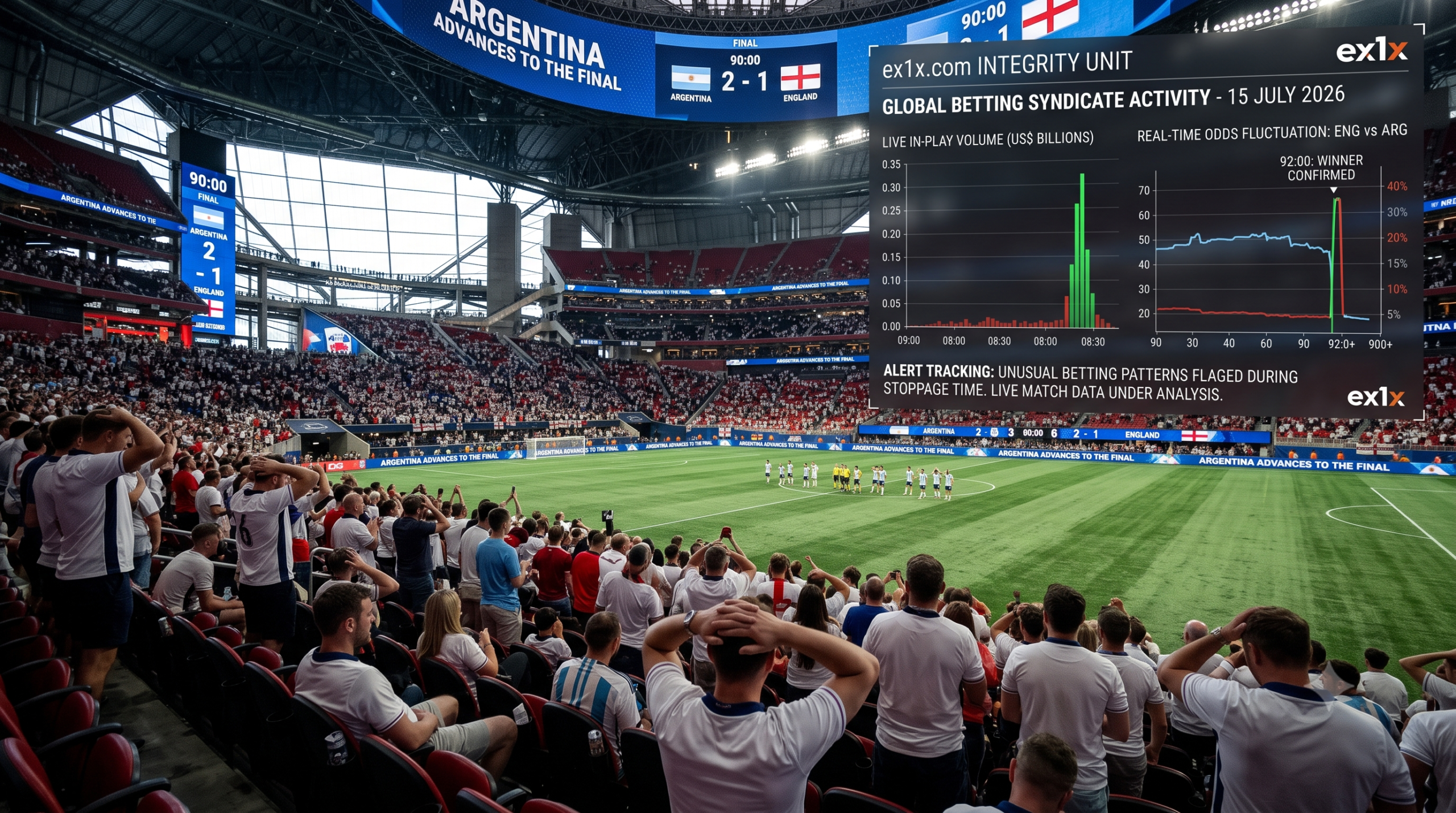
It was July 15, 2026, at Atlanta’s Mercedes-Benz Stadium. The stands were packed with thousands of tense fans, and on the pitch, one of the most high-voltage semifinals in football history was unfolding: Argentina versus England. When English winger Anthony Gordon scored a brilliant goal in the 55th minute to put England ahead, the roar of celebration from the English supporters shook the stadium.
At that exact moment, outside the stadium and across the digital universe, the mathematical calculations and algorithmic odds of international betting syndicates were shifting rapidly. While ordinary football fans celebrated, anticipating an English victory, a strange turn of events began behind the scenes.
In the 85th minute, Enzo Fernández scored a precise equalizer. The stadium’s real-time odds instantly flipped. Yet, the drama was not over. As the game pushed past regulation time into stoppage time, Lautaro Martínez delivered the winning strike in the 90+2 minute. The scoreboard read 2-1. Stunning England, Argentina advanced to the 2026 World Cup Final.
To billions of regular football viewers, this dramatic and emotional sequence looked like pure football magic. But to those who understand the underlying economics, global fintech liquidity, and the complex geometry of power, this was no sudden surprise. Instead, it mirrors a calculated pattern that has appeared in international sports under similar formulas for years.
2. The 2015 DOJ Indictment: Proof of Institutional Corruption
The most definitive and historic proof of this institutional issue was revealed to the world on May 27, 2015, through a historic indictment by the United States Department of Justice (DOJ). That day, a detailed complaint filed in the U.S. District Court for the Eastern District of New York charged nine top officials of football’s governing body, FIFA, and five corporate executives. The charges were not minor irregularities; they involved organized racketeering, wire fraud, international money laundering, and decades of global conspiracy.
The official statement from the U.S. Department of Justice clearly defined this dark chapter:
“It spans at least two generations of soccer officials who, as alleged, have abused their positions of trust to acquire millions of dollars in bribes and kickbacks.”
This single sentence from the U.S. court explains the internal ecosystem of the organization. It was not an isolated personal crime or a temporary error; it was an established institutional culture passed down from one generation to the next.
3. The Key Figures of the Syndicate and Their Legal Status
Federal court documents in the United States proved that in this 24-year-old network, older officials systematically taught the newer generation the global architecture of bribery. An analysis of the main figures in this circle reveals key names:
Jeffrey Webb: The former FIFA Vice President and CONCACAF President. He pleaded guilty in court and was ordered to forfeit more than $6.7 million to the U.S. government. Although FIFA banned him for life, he avoided prison and lives under a comfortable house arrest in the United States.
Jack Warner: The former President of CONCACAF and Vice President of FIFA, who was a central figure in this system. Banned for life from world football due to corruption, the U.S. sought his extradition. However, after more than a decade of international legal battles and political maneuvers, the High Court of Trinidad and Tobago permanently stayed his extradition in September 2025, keeping him outside international legal custody.
Chuck Blazer: A former member of the FIFA Executive Committee who wore a hidden audio recorder and an FBI wire to record secret meetings. In 2013, he pleaded guilty to massive tax evasion, money laundering, and racketeering, paying over $1.9 million in penalties before passing away in 2017.
Eduardo Li: The former head of the Costa Rican Football Federation, who, like other top officials, pleaded guilty to multiple corruption charges and agreed to forfeit over $668,000.
4. Data Analysis of 4 Knockout Matches
A statistical overlap has been observed between live betting volumes and on-pitch strategies across four specific knockout matches. While each event could be a coincidence, documenting these trends as a pattern remains a matter of journalistic record.
The Cape Verde Match: The game showed slow attacking plays and missed opportunities from the 1st to the 80th minute. Argentina’s live ratings dropped significantly, causing return odds to rise. In extra time, unusual spaces opened up in the opponent’s defensive line, and several refereeing decisions later faced intense public debate.
The Egypt Match: After Egypt took a 2-0 lead in the first half, massive capital entered global sportsbooks favoring Egypt. In the final 15 minutes of the second half, two controversial refereeing decisions occurred, prompting multiple bookmakers to flag the betting pattern in their integrity departments.
The Switzerland Match: Even after Switzerland was reduced to 10 players, the match extended into extra time. Pitch-side data tracking showed that live-odds fluctuations coincided with statistically unusual periods of back-passing in Argentina’s final third.
The England Semifinal: Following Gordon’s goal in the 55th minute, Enzo equalized in the 85th (1-1), and Lautaro secured the win in the 92nd (2-1). Broadcasting ratings and live betting volumes reached historic peaks during those 30 minutes. Analysts later noted that both Argentina’s attacking intensity between the 55th and 85th minutes and the positioning of the English defenders during Enzo’s shot appeared highly unusual.
***
Shaikh Rafiqul Islam (Rony)
Editor- ex1x.com